

Journal of Huntington's Disease Publishes Important Guidelines to Standardize Nomenclature in Huntington's Disease Research
The field of HD research is highly multidisciplinary, from molecular biology to clinical practice, and as understanding of the disease has progressed over the decades, a great deal of different terminology has accrued. The field is also renowned for its collaborative spirit and use of standardized reagents, assays, datasets, models, and clinical measures, so the use of standardized terms is especially important.
"We have set out to determine, through a consensus exercise involving basic and clinical scientists working in the field, the most appropriate language to use across disciplines. Nominally, this article will serve as the style guide for JHD, the only journal devoted exclusively to HD, and we lay out the preferred and standardized terminology and nomenclature for use in JHD publications. However, we hope that this article will also serve as a useful resource to the HD research community at large and that these recommended naming conventions may be adopted widely," says co-author Leslie M. Thompson, Departments of Psychiatry and Human Behavior and Neurobiology and Behavior, University of California, Irvine, and co-Editor-in-Chief of JHD.
An accompanying editorial highlights the development and publication of the Huntington’s Disease Integrated Staging System (HD-ISS), a new numerical staging system based on the biological classification for HD clinical research that was recently published.
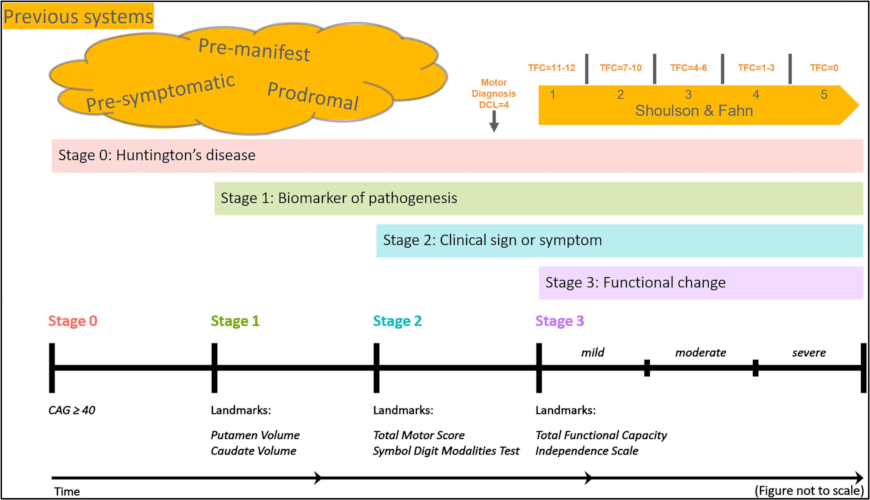
Caption: A schematic representation of how the Huntington’s Disease Integrated Staging System (HD-ISS) aligns with the terminology traditionally used in HD research. In this diagram: Clinical motor diagnosis, or a Diagnostic Confidence Level (DCL) of 4, corresponds to the latter part of HD-ISS stage 2. The Shoulson and Fahn stages, which are applicable after clinical motor diagnosis and are based on specific Total Functional Capacity (TFC) scores, overlap with the end of HD-ISS stage 2 and encompass all of stage 3. The figure also illustrates various terms used to denote periods before clinical motor diagnosis. Credit: Journal of Huntington's Disease.
Anne E. Rosser, Division of Psychological Medicine and Clinical Neurosciences, Brain Repair and Intracranial Neurotherapeutics (B.R.A.I.N.) Biomedical Research Unit, Cardiff University, co-author of the editorial and a member of the Huntington’s Disease Nomenclature Working Group, says, "The development and publication of the HD-ISS marks a significant milestone in the pursuit of standardizing and operationalizing terminology related to HD. Even more crucially, it contributes to the conceptual understanding of HD progression as a continuum that begins with the causal mutation in the HTT gene and continues through to the end of life. This system offers a more coherent and comprehensive framework to understand and study HD, particularly by enabling the clear definition of disease stages that occur before the emergence of clinical signs or symptoms. It enhances our ability to categorize and examine the disease’s progression in its earliest phases."
The adoption of the HD-ISS promises to resolve many inconsistencies in the clinical discourse surrounding HD. Simultaneously, this system equips the field with the tools to describe the continuum of HD progression more accurately, especially the very early stages. These initial stages, which have only recently become a focus of study, are particularly promising because they may reveal the most effective targets for disease-modifying therapies. Furthermore, for people with HD, the recognition of the disease status in the pre-symptomatic phase is empowering and respectful of their right to autonomy in decisions related to their health.
HD is an autosomal-dominant neurodegenerative condition; symptoms involve impairment in motor, cognitive, and behavioral/psychiatric domains, generally appearing during midlife with slowly progressive decline over the course of two decades. There is a wealth of scientific and clinical literature related to the disorder, but no disease-modifying treatment has been approved for HD yet.
--
Article:
“Towards Standardizing Nomenclature in Huntington’s Disease Research,” by Marian DiFiglia, Blair R. Leavitt, Douglas Macdonald, Leslie M. Thompson, and the Huntington’s Disease Nomenclature Working Group (https://doi.org/10.3233/JHD-240044). Openly available.
Accompanying Editorial:
“Refining the Language of Huntington’s Disease Progression with the Huntington’s Disease Integrated Staging System (HD-ISS),” by Cristina Sampaio, Sandra K. Kostyk, Sarah J. Tabrizi, and Anne E. Rosser (https://doi.org/10.3233/JHD-240043). Openly available.

