

As the years add up, it's common to notice slight changes in our ability to remember and think. Older people who have more marked changes than their peers can be diagnosed with mild cognitive impairment (MCI). Currently, we can’t easily predict which of these patients will develop Alzheimer’s disease and which will not.
“It's hard to predict which patients will have a more rapid progression and receive a diagnosis of dementia,” said Maria Vittoria Spampinato, M.D., division director of Neuroradiology at the Medical University of South Carolina.
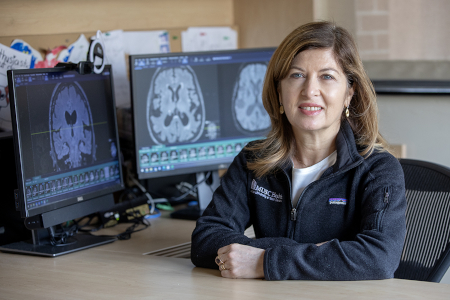
Caption: Dr. Maria Vittoria Spampinato, division director of Neuroradiology
“It’s important to know who is likely to progress to dementia, as they will need a lot of support and assistance from their family and other caregivers,” she continued.
To improve our ability to predict progression to AD, Spampinato and her team looked at the connection between neuropsychiatric symptoms (NPS), such as worsened anxiety and depression, and the journey from MCI to dementia, specifically AD. Their findings, recently reported in the Journal of Alzheimer’s Disease, show that NPS is a useful model for predicting progression to AD.
Alzheimer's disease can be described as a glitch in the brain's communication system. The brain “glitches” because certain proteins clump abnormally, disrupting brain function. The two main types of clumping proteins are beta-amyloid plaques and tau tangles. These proteins can disrupt brain function by forming between or within neurons, leading to memory loss, problem-solving issues and, ultimately, difficulty completing daily tasks.
Spampinato and her team hoped to find out if NPS could be a simple and noninvasive method for tracking disease progression.
“Although it’s important to do lab testing to measure the number of amyloid plaques and tau disease, NPS testing is important in identifying which patients are at greater risk,” she said.
To test whether NPS could help to predict MCI to AD progression, the MUSC team identified 300 MCI patients ages 65 and older from the Alzheimer’s Disease Neuroimaging Initiative database. Patients were given the Neuropsychiatric Inventory (NPI) to document symptoms, such as anxiety, depression, delusions, hallucinations, abnormal movement behavior and sleep disorders — collectively known as NPS — as potential early signs of preclinical AD to establish a prediction model for AD.
The study findings showed that more than a quarter of the MCI patients went on to develop AD. For each one-point increase in NPI score, there was a 3% increase in the risk of mental decline leading to the diagnosis of AD.
Surprisingly, the study showed that NPS predicted the risk of mental decline better than certain established risk factors of AD.
Based on these findings, Spampinato recommends that MCI patients be screened for NPS, as it is an important factor to consider for predicting disease progression.
“If you feel down or anxious and you experience memory issues as you age, it is important to seek help early and get a thorough evaluation for both cognitive and mental health concerns,” said Spampinato.
The prediction model developed by Spampinato and her team shows promise for identifying which patients with MCI will progress to AD. However, it will need validating in a larger group of patients recruited from memory care institutions before being used in the clinic.
The study’s findings emphasize the importance of considering NPS in the early diagnosis and treatment of preclinical AD. They also set the stage for future research aimed at unraveling the mechanisms underlying the progression from MCI to AD.
# # #
NOTES FOR EDITORS
Reference
Spampinato MV, et al; Alzheimer’s Disease Neuroimaging Initiative. Neuropsychiatric symptoms and in vivo Alzheimer's biomarkers in mild cognitive impairment. Journal of Alzheimer’s Disease 2023; 96(4):1827-1836. (https://doi.org/10.3233/JAD-220835)
About Medical University of South Carolina
Founded in 1824 in Charleston, MUSC is the state’s only comprehensive academic health system, with a unique mission to preserve and optimize human life in South Carolina through education, research and patient care. Each year, MUSC educates more than 3,200 students in six colleges – Dental Medicine, Graduate Studies, Health Professions, Medicine, Nursing and Pharmacy – and trains more than 900 residents and fellows in its health system. MUSC brought in more than $300 million in research funds in fiscal year 2023, leading the state overall in research funding. MUSC also leads the state in federal and National Institutes of Health funding. For information on academic programs, visit musc.edu.
As the health care system of the Medical University of South Carolina, MUSC Health is dedicated to delivering the highest-quality and safest patient care while educating and training generations of outstanding health care providers and leaders to serve the people of South Carolina and beyond. Patient care is provided at 16 hospitals (includes owned or governing interest), with approximately 2,700 beds and four additional hospital locations in development, more than 350 telehealth sites and nearly 750 care locations situated in all regions of South Carolina. In 2023, for the ninth consecutive year, U.S. News & World Report named MUSC Health University Medical Center in Charleston the No. 1 hospital in South Carolina. To learn more about clinical patient services, visit muschealth.org.
MUSC has a total enterprise annual operating budget of $5.9 billion. The nearly 26,000 MUSC family members include world-class faculty, physicians, specialty providers, scientists, students, affiliates and care team members who deliver groundbreaking education, research, and patient care.
About the Journal of Alzheimer’s Disease
Now in its 27th year of publication, the Journal of Alzheimer’s Disease (JAD) is an international multidisciplinary journal to facilitate progress in understanding the etiology, pathogenesis, epidemiology, genetics, behavior, treatment, and psychology of Alzheimer’s disease. The journal publishes research reports, reviews, short communications, book reviews, and letters-to-the-editor. Groundbreaking research that has appeared in the journal includes novel therapeutic targets, mechanisms of disease, and clinical trial outcomes. JAD has a Journal Impact Factor of 4 according to Journal Citation Reports (Clarivate, 2023). The journal is published by IOS Press. j-alz.com
About IOS Press
IOS Press is an international scientific, technical, medical (STM) publishing house established in 1987 in Amsterdam. We produce around 90 journals and 70 books annually in a broad range of subject categories, primarily specializing in health and life sciences (including neurosciences, medical informatics, cancer research, and rehabilitation) and computer sciences (including artificial intelligence, data science, and semantic web). In addition, we offer specialized services that support scientific advancement. iospress.com

